How to Grow a Small Instagram Account With Simple Steps
 Aiden Parker··13 min read

Growing a small Instagram account takes simple steps that work, including choosing a narrow audience, publishing useful content consistently, making your profile easy to understand, and improving from weekly data instead of chasing random trends. The fastest sustainable growth usually comes from helping the same type of person repeatedly, then giving that person a clear reason to follow, save, share, or contact you.
Key Takeaways
- Define one specific audience, such as beginner home cooks, budget travelers, or local wedding photographers.
- Turn your profile into a clear landing page with a searchable name, useful bio, and one obvious next step.
- Use Reels for discovery, carousels for saves, Stories for trust, and Lives or collaborations for conversation.
- Publish on a manageable weekly schedule rather than posting intensely for three days and disappearing.
- Review reach, watch time, saves, shares, profile visits, and follows every week.
- Avoid buying followers, copying content, or using unrelated hashtags; these tactics weaken audience quality.
How to Grow a Small Instagram Account
1. Pick one clear promise
People follow accounts when they quickly understand what they will receive. “Lifestyle” is too broad. “Five-minute vegetarian lunches for busy parents” is specific enough to attract the right people and guide your content.
Write a one-sentence promise:
I help [specific person] achieve [specific result] with [your method or point of view].
Examples include:
- “I help first-time renters decorate small apartments without permanent changes.”
- “I teach new runners how to train for their first 5K.”
- “I share affordable skincare routines for sensitive skin.”
- “I show independent coffee shops how to create better menu photos.”
A narrow focus doesn’t trap you forever. It gives your account a recognizable starting point. You can expand after you understand which topics consistently attract qualified followers.
2. Define three content pillars
Your pillars are recurring subject areas that make planning easier. Choose three that support your promise:
- Teach: tutorials, checklists, demonstrations, or explanations.
- Prove: before-and-after examples, process clips, customer results, or detailed case breakdowns.
- Connect: opinions, behind-the-scenes moments, personal lessons, or audience questions.
For a home organization account, pillars might be closet systems, decluttering decisions, and small-space routines. For a fitness account, they might be beginner exercises, form corrections, and realistic meal ideas.
Don’t create pillars that are merely formats, such as “Reels,” “photos,” and “Stories.” A format tells you how to publish; a pillar tells you what your audience needs.
Make Your Profile Convert
A profile visit is a valuable opportunity. Treat your profile like a small storefront: visitors should know who you help, what you offer, and what to do next within seconds.
Improve these profile elements
- Username: Use a readable name connected to your topic, such as
@MayaMakesBreadrather than a string of random numbers. - Name field: Add searchable words, such as “Austin Realtor,” “Beginner Running Coach,” or “Budget Travel.”
- Profile photo: Use a bright face photo for a personal brand or a simple, recognizable logo for a business.
- Bio: State the audience, outcome, and content type: “Simple plant care for apartment beginners | Weekly care guides.”
- Link: Send visitors to one useful destination, such as a booking page, newsletter, free guide, or product collection.
- Pinned posts: Pin an introduction, your best educational post, and a proof or offer post.
Your first pinned post should answer, “Why should I follow this account?” Your second should demonstrate your expertise. Your third can explain how to work with you or find your best resources.
Profile test: Ask three people who don’t know your account to describe it after five seconds. If their answers differ widely, simplify the profile.
Build a Repeatable Content System

Consistency becomes easier when each post follows a repeatable production process. Create ideas in batches, record several pieces at once, and keep a simple list of hooks, examples, and questions.
A useful weekly mix looks like this:
| Content type | Main job | Example for a baking account |
|---|---|---|
| Short video | Reach new people | “Why your cookies spread too much” |
| Carousel | Earn saves and shares | “Seven signs your sourdough starter needs help” |
| Story sequence | Build familiarity | Grocery haul, poll, and baking test |
| Offer or proof post | Generate action | Cake order process or customer photo |
Use Reels for discovery
Make the first frame or spoken sentence specific. “Three ways to improve your phone photos” is stronger than “Come with me today.” Show the result early, remove pauses, and add readable captions because many people watch without sound.
Use a simple structure:
- State the problem.
- Show or explain the fix.
- Give one example.
- End with a relevant action.
Good calls to action include “Save this for your next grocery trip,” “Send this to a new dog owner,” or “Comment with the part you want explained next.” Avoid asking for likes when a save, share, or question is more useful.
Use carousels for depth
A carousel should have one job, not five unrelated tips. Put the promise on slide one, provide one idea per slide, and finish with a concise summary or next step.
Strong carousel subjects include:
- “The three camera settings I use for indoor product photos.”
- “A renter-friendly Sunday reset for a studio apartment.”
- “What to pack for a two-day winter road trip.”
- “Five email subject lines for a local service business.”
Use Stories for trust
Stories work well for informal interaction. Use polls, question stickers, quizzes, countdowns, and link stickers when each one supports a clear purpose. A sequence of three to seven connected frames is usually easier to follow than fifteen unrelated updates.
Show real process: preparing an order, choosing between two designs, answering a customer question, or correcting a common mistake. Trust grows when followers see how you think, not only polished finished results.
Create Posts People Share
Reach is useful, but meaningful actions are better signals of content value. Shares expose your post to another person’s audience; saves indicate future usefulness; comments reveal questions and objections.
Before publishing, ask:
- Would someone save this before a trip, appointment, project, or purchase?
- Could a follower send it to a friend without adding an explanation?
- Does it solve one recognizable problem?
- Is the first sentence clear without background context?
- Does the visual support the point rather than distract from it?
Use specific examples instead of generic encouragement. “Be more organized” is weak. “Put a labeled basket beside the door for library books and returns” gives the reader something to do.
For visual quality, prioritize a clean background, natural light, readable text, and consistent framing. You don’t need expensive equipment. A phone, a window, a basic tripod, and a quiet recording space can produce useful content when the idea is strong.
Pro Tip: Keep a running “questions” note in your phone. Add every question from comments, direct messages, customer calls, and conversations. Each question can become a Reel, carousel, Story poll, or live discussion.
Use Instagram Search
Instagram search can help people find smaller accounts when captions, profile fields, and on-screen text use the words people actually type. Think like your audience, not like an industry insider.
Someone looking for meal help may search “high-protein lunch,” while a professional may call the same subject “macronutrient-balanced midday meal.” Use the audience’s language in natural sentences.
Add one primary phrase to:
- Your name field, such as “Denver Wedding Florist.”
- Your bio, where it fits naturally.
- The first sentence of a caption.
- On-screen text and spoken audio.
- Alt text or a descriptive caption when appropriate.
Hashtags can provide context, but they aren’t a substitute for a clear topic. Choose a small set of relevant terms such as #BeginnerGardening, #AustinFoodie, or #SmallApartmentDecor instead of stuffing every post with broad tags.
Instagram’s recommendation systems apply eligibility rules to content shown to people who don’t already follow an account. Review the Instagram recommendation guidelines before relying on borderline, sensational, or recycled content for reach.
Engage Without Spamming
Engagement works best when it starts a relevant conversation. Spend a short, focused period responding to comments and visiting accounts where your ideal followers already participate.
Useful actions include:
- Answering a question under your own post with an example.
- Leaving a thoughtful comment on a local business’s related post.
- Replying to a Story poll with a helpful follow-up.
- Sharing a follower’s project with permission.
- Sending a personal message after someone asks for a resource.
Avoid copying the same comment onto dozens of posts, sending unsolicited sales pitches, or commenting only with fire emojis. Those actions create activity without building real relationships.
Create conversation prompts that are easy to answer: “Which room is hardest to organize?” Is better than “What do you think?” If someone gives a detailed answer, respond with another useful detail rather than immediately directing them to your offer.
Collaborate for Discovery
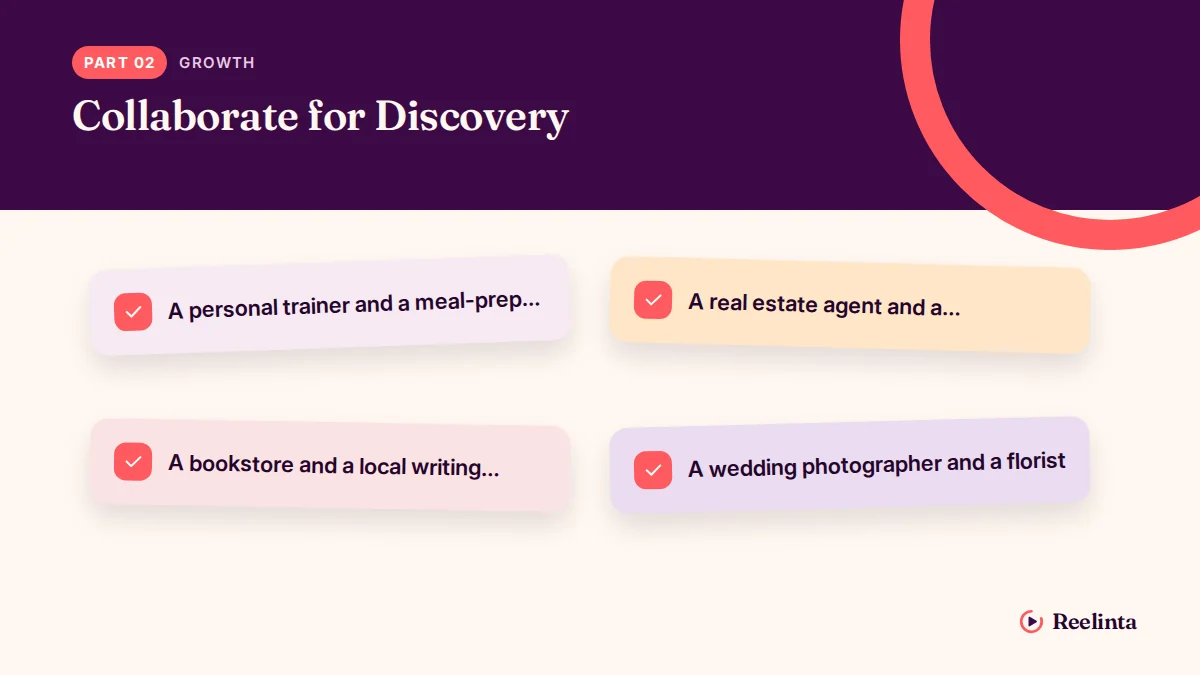
A collaboration places your account in front of a related audience that already has context for your subject. Choose partners based on audience overlap, not follower count alone.
Potential partners include:
- A personal trainer and a meal-prep creator.
- A real estate agent and a home inspector.
- A bookstore and a local writing teacher.
- A wedding photographer and a florist.
- A dog groomer and a positive-reinforcement trainer.
Use Instagram’s Collab feature when both accounts genuinely contribute. You can also make a joint Reel, host a live conversation, exchange Story recommendations, or create a shared checklist.
Before agreeing, define the topic, format, publishing date, approval process, and call to action. A collaboration should give viewers a reason to follow both accounts. “Follow us both” is weaker than “Follow each account for the two halves of this renter move-in checklist.”
Warning: Don’t participate in engagement pods or follower giveaways that attract people unrelated to your niche. A large spike from uninterested accounts can leave you with low views and weak interactions later.
Read Your Metrics Weekly
Don’t judge an account from one post. Review a seven-day or 30-day period and compare similar formats with similar goals.
| Metric | What it suggests | What to change |
|---|---|---|
| Accounts reached | Discovery and distribution | Improve topic, hook, or collaboration |
| Average watch time | Video retention | Shorten the intro and show the payoff sooner |
| Saves | Practical usefulness | Create checklists, steps, and reference posts |
| Shares | Relatability or utility | Add stronger examples and sendable advice |
| Profile visits | Interest after exposure | Improve the hook and topic match |
| Follows from post | Profile conversion | Clarify the bio and pin better posts |
| Story replies | Trust and conversation | Ask narrower questions and show more process |
Look for patterns, not vanity numbers. If one Reel gets many views but few profile visits, its topic may be entertaining but disconnected from your account promise. If a carousel reaches fewer people but generates many saves, make more content with that structure.
Track your top five posts each month in a spreadsheet. Record the topic, format, opening hook, length, reach, saves, shares, comments, profile visits, and follows. After four weeks, repeat the themes that produced the strongest meaningful actions.
Follow a 30-Day Growth Schedule
A simple schedule prevents perfectionism. Adjust the volume to your time, but keep the quality and topic focus steady.
| Days | Publishing plan | Growth task |
|---|---|---|
| 1–3 | Rewrite bio and pin three posts | Ask three people to describe your account |
| 4–7 | Publish two Reels and one carousel | Reply to every genuine comment |
| 8–10 | Publish Stories on two days | Run one poll and collect questions |
| 11–14 | Publish one tutorial and one opinion post | Contact two relevant collaboration partners |
| 15–18 | Publish two Reels | Review watch time and improve weak openings |
| 19–21 | Publish one saveable carousel | Share a useful follower response |
| 22–25 | Host a short Live or joint Reel | Answer recurring questions publicly |
| 26–28 | Publish one proof or process post | Update your pinned content if needed |
| 29–30 | Publish a recap or best tip | Compare metrics and choose next month’s themes |
A realistic weekly baseline might be two short videos, one carousel, and Stories on four days. If that’s too much, begin with one video, one carousel, and three Story sessions. Sustainable frequency beats an ambitious schedule you can’t maintain.
Batch related tasks: outline captions on Monday, record videos on Tuesday, edit on Wednesday, and schedule or publish later. Keep a folder of reusable footage such as product close-ups, workspace scenes, walking shots, and hands demonstrating a process.
Fix Common Growth Problems
“My posts get views but no follows”
Your content may be reaching people without explaining why they should stay. Add a follow-worthy series, improve your bio, and connect every post to your account promise.
Try:
- A recurring title such as “Rental Kitchen Fixes.”
- A pinned “Start Here” tutorial.
- A closing line that explains what future posts cover.
- A profile photo and name field that clearly identify your topic.
“My reach suddenly dropped”
First, check whether your posting frequency, topic, format, or audience changed. Also review account status and remove content that may violate platform rules. One low-performing post is normal; a month-long decline requires investigation.
Compare the last ten posts with the previous ten:
| Possible cause | Evidence to check | Practical response |
|---|---|---|
| Weak opening | Low watch time in the first seconds | State the outcome immediately |
| Topic drift | Fewer profile visits and follows | Return to your three pillars |
| Repetitive format | Falling shares and saves | Test a carousel, Story, or collaboration |
| Low audience fit | Views from unrelated accounts | Stop broad giveaways and vague hashtags |
| Inconsistent publishing | Long gaps between posts | Use a smaller repeatable schedule |
“I have no ideas”
Use your existing audience as an idea generator. Search your comments, direct messages, emails, customer reviews, and competitor discussions for repeated questions. Turn one answer into several formats: a short demonstration, a checklist, a myth correction, and a Story quiz.
“I feel awkward on camera”
You can grow without speaking directly to the lens. Film hands, objects, screen recordings, demonstrations, or voiceovers. Use captions and clear visuals. Over time, add brief appearances if they help your audience recognize and trust you.
Never buy followers or use automated engagement. Those accounts rarely become customers, and inflated numbers make your genuine performance harder to interpret.
Frequently Asked Questions
How often should a small Instagram account post?
Start with one to three feed posts and three to five Story sessions per week. Choose a pace you can maintain for at least two months. A smaller schedule with useful, focused content is better than daily posts that repeat themselves or cause burnout.
How long does Instagram growth take?
There’s no reliable universal timeline. Growth depends on topic demand, content quality, consistency, audience fit, and distribution. Evaluate progress over 30- to 90-day periods using reach, saves, shares, profile visits, and relevant inquiries rather than follower count alone.
Should I use hashtags on every post?
Use relevant hashtags when they accurately describe the post, location, audience, or subject. Don’t rely on them as your primary discovery strategy. Clear captions, searchable profile language, useful topics, and shareable content usually provide stronger direction.
Are Instagram Reels better than photos?
Reels often offer more opportunities for discovery, while photos and carousels can be stronger for education, saves, and brand presentation. Use the format that best serves the idea. A concise carousel can outperform a weak video because it solves a clearer problem.
Should I switch to a professional account?
A professional account can provide tools such as insights, contact options, and professional features. Switch if you need those tools for a business, creator project, or nonprofit. The account type itself can’t replace a clear niche, useful content, or audience interaction.
Why do people watch but not follow?
Viewers may enjoy an individual post without seeing a reason to expect more. Make your topic consistent, state what the account delivers, use recurring series, improve your bio, and pin an introduction. A strong post earns attention; a coherent profile earns the follow.
Conclusion
Choose one audience, rewrite your profile promise today, and plan the next seven posts around three specific questions that audience asks. At the end of the week, record which posts earned saves, shares, profile visits, and follows. Use those signals to build the following week instead of starting from scratch.
Aiden Parker writes about Instagram strategy, features, and growth, covering everything from captions and hashtags to algorithms, analytics, and audience engagement. His content explores Reels, Stories, Highlights, profile optimization, and Instagram for Business, offering practical insights to help creators and businesses improve their content, reach the right audience, and build a stronger presence on the platform.