Instagram Growth Strategy: The Complete Guide to Sustainable Growth
 Aiden Parker··12 min read
If you searched for an instagram growth strategy, you probably want more than posting often and hoping for followers. Sustainable growth comes from a clear audience, repeatable content, meaningful interactions, search-friendly packaging, and regular measurement. This guide turns those pieces into a practical system for attracting the right people and converting attention into trust, leads, or sales.
Key Takeaways
- Choose one primary growth outcome, such as profile visits, email subscribers, or qualified inquiries.
- Build three to five repeatable content pillars so your audience knows what to expect.
- Optimize every post for discovery with searchable wording, strong hooks, descriptive captions, and relevant topics.
- Treat comments, shares, saves, profile visits, and follows as different signals rather than one combined “engagement” number.
- Review performance weekly, then make one controlled change at a time.
- Avoid purchased followers, engagement pods, copied content, and misleading tactics that damage audience quality.
Build an Instagram Growth Strategy
Growth becomes easier to manage when you separate attention from business results. A viral Reel may create thousands of views but few customers; a useful carousel might reach fewer people while generating strong saves and inquiries.
Start by writing a one-sentence account promise:
“I help [specific audience] achieve [specific result] through [your distinctive approach].”
Examples include:
- A meal-prep coach helping busy parents cook affordable weekday dinners.
- A local dentist explaining preventive care in plain English.
- A handmade jewelry shop showing durable, giftable pieces for minimalist wardrobes.
- A B2B software consultant helping small agencies automate reporting.
Pick one primary objective
Choose one main outcome for the next 60 to 90 days. Supporting metrics can still matter, but one priority prevents scattered decisions.
| Primary objective | Best leading indicators | Useful conversion action |
|---|---|---|
| Reach new people | Non-follower reach, shares, watch time | Follow, profile visit |
| Build trust | Saves, thoughtful comments, repeat viewers | Email signup, consultation |
| Generate leads | Profile visits, link taps, direct messages | Form completion, booked call |
| Sell products | Product views, DMs, website sessions | Purchase, add to cart |
Your profile promise should match the objective. If you want leads, explain who you help, what outcome you provide, and how someone can contact you. If you want local customers, include your service area and a direct reason to visit.
Define your audience narrowly
“Women,” “entrepreneurs,” or “people who like fitness” is too broad to guide content. Describe a person’s situation, problem, desired result, objections, and vocabulary.
For example, “first-time apartment renters in Chicago who need inexpensive storage ideas” produces much better content decisions than “home decor fans.”
Define Your Content Pillars
Content pillars are recurring subjects that make planning simpler without forcing every post to look identical. Most accounts can begin with three to five pillars.
A useful mix includes:
- Teach: Tutorials, checklists, explanations, and mistakes to avoid.
- Prove: Demonstrations, before-and-after examples, processes, and product details.
- Relate: Opinions, customer questions, personal lessons, and common frustrations.
- Invite: Polls, questions, challenges, behind-the-scenes posts, and community prompts.
- Convert: Offers, service explanations, product comparisons, and calls to action.
For a personal trainer, pillars might be strength training for beginners, realistic meal habits, mobility routines, client questions, and coaching offers. For a coffee shop, they might be brewing education, seasonal drinks, staff stories, local events, and customer features.
Match formats to jobs
Use formats according to what they communicate well:
- Reels: Demonstrations, transformations, quick explanations, and personality.
- Carousels: Step-by-step teaching, comparisons, frameworks, and lists.
- Stories: Timely updates, informal conversation, polls, and reminders.
- Live video: Q&A sessions, launches, interviews, and demonstrations.
- Single images: Strong statements, product details, announcements, or visual branding.
Don’t force every idea into a Reel. A six-slide carousel may explain a complex process more clearly than a fast video, while Stories may be better for a same-day promotion.
Create Discoverable Posts
Discovery depends on whether Instagram and its users can understand the subject of your content quickly. Put the topic in the spoken words, on-screen text, caption, and relevant profile fields when natural.
Write stronger hooks
A hook should identify a problem, promise a useful result, or create a specific reason to continue. Avoid vague openings such as “You need to hear this.”
Try:
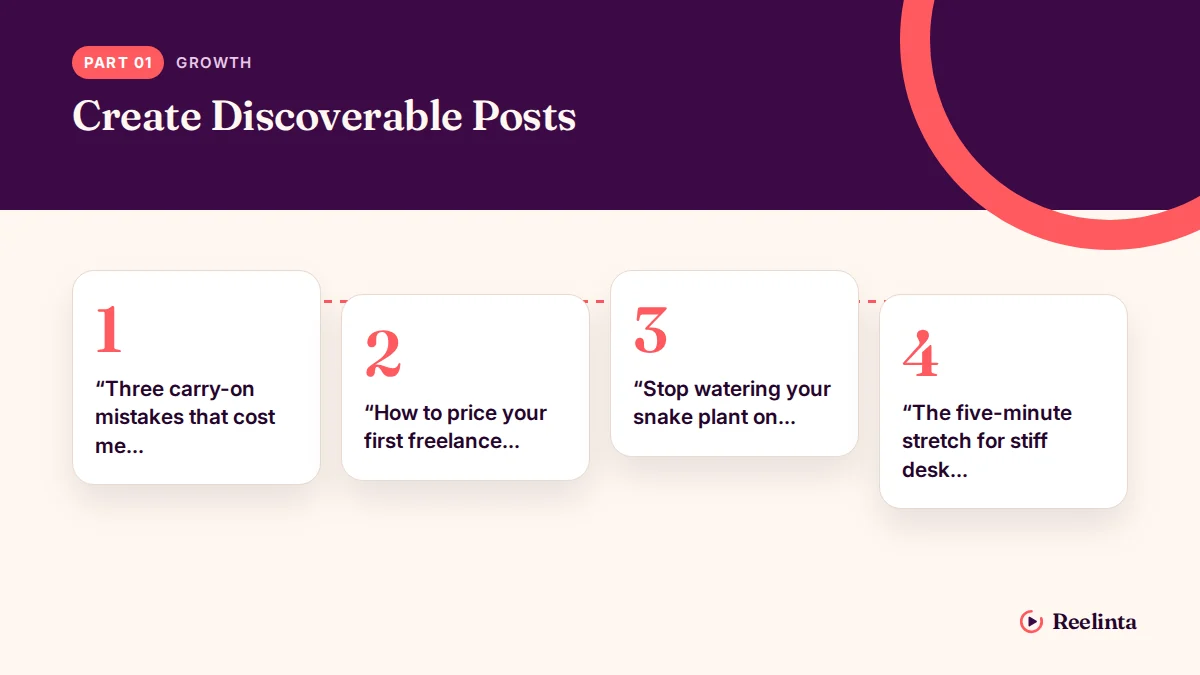
- “Three carry-on mistakes that cost me packing space.”
- “How to price your first freelance package.”
- “Stop watering your snake plant on this schedule.”
- “The five-minute stretch for stiff desk shoulders.”
- “What I would change before opening a second location.”
Make the first frame readable without sound. Use large, high-contrast text and remove introductory material that doesn’t earn attention.
Improve captions and accessibility
Use the first sentence to clarify the value. Add context, examples, and a simple next step. Alt text and captions help people understand content in different viewing situations, while accurate subtitles make spoken information easier to follow.
Use topic language naturally rather than filling captions with unrelated keywords. Ten precise hashtags aren’t automatically better than three relevant ones. Hashtags should describe the subject, audience, location, or use case—not merely the size of the potential audience.
Pro Tip: Before publishing, ask a stranger to identify the post’s subject from the cover, first frame, and opening sentence. If they cannot, simplify the packaging before adding more hashtags.
Instagram’s eligibility and recommendation systems can change, so review its Recommendation Guidelines before relying on content intended for non-follower distribution.
Use Instagram Search
Instagram search is especially useful for service providers, educators, local businesses, and niche creators. Treat your profile like a small landing page that answers what you do, who you serve, and where you operate.
Update these areas:
- Name field: Include a plain-language category, such as “Austin Wedding Photographer.”
- Bio: State the audience, result, and relevant differentiator.
- Captions: Use phrases your audience would actually type.
- On-screen text: Name the subject clearly in the opening seconds.
- Location signals: Mention the city, neighborhood, or service area when relevant.
- Alt text: Describe the actual image or instructional content.
Avoid awkward repetition. “New York budget interior design for New York apartments” sounds robotic and reduces trust. Write for humans first, then make the subject unmistakable.
Build topic clusters
Create several posts around one subject from different angles. A tax preparer might publish:
- “Quarterly taxes for freelancers”
- “How to track deductible software”
- “Estimated tax payment mistakes”
- “Tax questions to ask before hiring an accountant”
These posts can link conceptually through captions, Stories, and pinned content. A visitor who finds one useful post should immediately see related material on the profile.
Publish With a Sustainable Schedule
Consistency means maintaining a useful publishing rhythm, not posting at maximum volume. Choose a schedule your team can support for at least eight weeks.
A starting schedule might look like this:
| Day | Main content | Supporting action | Purpose |
|---|---|---|---|
| Monday | Educational carousel | Reply to weekend comments | Establish expertise |
| Tuesday | Short Reel | Share a poll in Stories | Reach and interaction |
| Wednesday | Customer or process post | Answer relevant DMs | Build trust |
| Thursday | Tutorial Reel | Reshare responses | Teach and clarify |
| Friday | Offer or opinion post | Invite questions | Drive action |
| Saturday | Stories or local content | Comment thoughtfully on peers | Stay present |
| Sunday | No feed post or recap | Review saved ideas | Prepare next week |
The exact number matters less than quality and consistency. Batch similar tasks: write several hooks together, record multiple videos in one session, and create templates for recurring carousels.
Build a content bank
Keep a running list of:
- Questions from DMs and sales calls.
- Comments that reveal confusion or objections.
- Search phrases related to your service.
- Customer mistakes and successful outcomes.
- Seasonal dates, product launches, and local events.
- Posts from competitors that prompt a useful disagreement.
Use a spreadsheet with columns for topic, pillar, format, hook, call to action, status, and result. This turns inspiration into an operating system.
Grow Through Community
Publishing starts the conversation; participation sustains it. Reply to comments with more than emojis, ask follow-up questions, and recognize the specific point someone made.
Meaningful community actions include:
- Answering a beginner’s question with a clear example.
- Thanking a customer and asking how they used the product.
- Commenting on a local partner’s event announcement.
- Sharing a follower’s result with permission.
- Sending a useful resource when someone asks for help.
- Using Story polls to choose between two legitimate options.
Don’t automate generic comments such as “Great post!” Across unrelated accounts. They can make your brand look inattentive and attract low-quality interactions.
Design better calls to action
Use one primary call to action per post:
- “Save this checklist for your next move.”
- “Comment with the ingredient you struggle to use.”
- “Send me ‘AUDIT’ if you want the service details.”
- “Visit the link in bio to download the template.”
- “Share this with a friend planning a budget wedding.”
The action should fit the post. Asking for a purchase after a shallow, unrelated post creates friction; asking for a save after a genuinely useful checklist feels natural.
Warning: Never buy followers, likes, or comments. Inflated numbers obscure your real audience, weaken engagement quality, and can leave you making decisions from false data.
Collaborate and Distribute
Collaboration introduces your account to an audience that already has context. Look for complementary businesses and creators with overlapping customers, not merely large follower counts.
Strong partnership ideas include:
- A yoga instructor and a physical therapist discussing safe mobility.
- A florist and a wedding photographer creating a planning checklist.
- A real estate agent and a home inspector explaining inspection surprises.
- A bookstore and a local café hosting a themed reading event.
- A skincare educator and a licensed esthetician answering routine questions.
Use Instagram’s collaboration features when both accounts genuinely contribute. Also repurpose ideas across your own channels: turn a Reel into an email explanation, a carousel into a LinkedIn post, or a customer question into a Story sequence.
Evaluate partners
| Partner signal | Why it matters | What to check |
|---|---|---|
| Audience overlap | Reaches likely prospects | Comments, topics, customer type |
| Credibility | Transfers relevant trust | Expertise, consistency, transparency |
| Interaction quality | Predicts useful attention | Specific comments, saves, questions |
| Operational fit | Prevents missed deadlines | Approval process, assets, timing |
| Offer compatibility | Avoids confusing followers | Complementary, not competing, products |
Agree on deliverables before publishing: format, deadline, tags, approval rights, disclosure language, and how inquiries will be handled.
Measure What Matters
Use a simple weekly review rather than reacting to every post. Compare similar formats and topics over time; a tutorial Reel shouldn’t be judged against a product announcement using the same expectations.
Track these metrics:
- Reach: How many accounts saw the content.
- Non-follower reach: Whether discovery is expanding.
- Average watch time: Whether video holds attention.
- Completion rate: Whether viewers stay through the content.
- Shares: Whether the post has social usefulness.
- Saves: Whether it has future reference value.
- Profile visits: Whether content creates curiosity.
- Website taps or DMs: Whether attention moves toward action.
- Follows: Whether the account promise persuades visitors.
A practical review table can keep decisions focused:
| Signal | Possible interpretation | Next experiment |
|---|---|---|
| High reach, few follows | Packaging attracts the wrong people or profile is unclear | Rewrite bio and pin an introduction |
| Low reach, high saves | Content is useful but poorly packaged | Test a stronger hook and cover |
| High views, low watch time | Opening is slow or unclear | Cut the introduction |
| High comments, few leads | Conversation isn’t connected to an offer | Add a relevant next step |
| High profile visits, low action | Profile lacks proof or direction | Improve bio, highlights, and CTA |
Don’t chase every outlier. Record the topic, format, hook, length, posting time, audience split, and conversion action. After several comparable posts, choose the pattern worth repeating.
Fix Stalled Growth
A plateau usually has a diagnosable bottleneck. Start with the experience a new visitor has after clicking your profile, then work backward to reach and retention.
Common causes and fixes
| Problem | Likely cause | Practical fix |
|---|---|---|
| Followers rise but sales do not | Audience or offer mismatch | Define a qualified follower and publish buying guidance |
| Reels get views but no retention | Weak opening or unclear promise | Show the outcome first |
| Posts feel inconsistent | Too many unrelated pillars | Remove low-priority topics |
| Engagement is mostly from friends | Content isn’t reaching the target audience | Use niche topics and relevant collaborations |
| Content is useful but invisible | Poor search language or packaging | Name the problem in the cover and caption |
| Growth stopped after a strong month | One topic was overused or trend-dependent | Build adjacent topics and evergreen series |
| DMs are overwhelming | No intake process | Use saved replies and a qualification question |
Review your pinned posts, bio, highlights, and recent grid as a stranger would. A visitor should understand the account within seconds and find proof that it delivers on its promise.
Pro Tip: Run a 14-day diagnostic before changing everything. Keep your audience and offer steady while testing only one variable—hook, format, topic, CTA, or posting cadence—so the result teaches you something.
Frequently Asked Questions
How often should I post on Instagram?
Choose the highest schedule you can maintain without lowering usefulness or responsiveness. For many small accounts, three to five feed posts weekly plus regular Stories is a workable starting range. Test it for at least several weeks, then adjust based on reach, retention, saves, profile actions, and your available production time.
How long does Instagram growth take?
There’s no reliable universal timeline. Growth depends on audience size, niche demand, content quality, distribution, consistency, and the strength of your profile promise. Judge progress through improving non-follower reach, qualified profile visits, saves, conversations, and conversions rather than expecting a specific follower number by a specific date.
Should I switch to a professional account?
A professional account is generally useful for brands, creators, and service providers because it provides business features and performance information. Switch when you need those tools, but don’t assume the account type alone will create growth. Clear positioning, useful content, and relevant audience signals remain the foundation.
Are hashtags still important for Instagram growth?
Hashtags can provide context, but they aren’t a substitute for a clear topic, strong hook, useful content, and audience interaction. Use a small set that accurately describes the subject, audience, or location. Avoid unrelated high-volume tags because they may attract attention from people who will never value your account.
Should I delete posts that perform poorly?
Usually, no. A weak post may still provide context, social proof, or a useful lesson. Consider archiving content that’s inaccurate, off-brand, outdated, or confusing to prospective customers. Before removing a post, identify what failed—topic, hook, format, timing, or offer—and apply that lesson to the next version.
Conclusion
Build your next 14 days around one audience, three content pillars, one primary objective, and a manageable schedule. Publish the first few pieces, record the signals that matter, and make one deliberate improvement each week. Consistent learning will produce a stronger Instagram presence than chasing every trend.
Aiden Parker writes about Instagram strategy, features, and growth, covering everything from captions and hashtags to algorithms, analytics, and audience engagement. His content explores Reels, Stories, Highlights, profile optimization, and Instagram for Business, offering practical insights to help creators and businesses improve their content, reach the right audience, and build a stronger presence on the platform.