Instagram Reel Hooks: What They Are and How They Work
 Aiden Parker··10 min read
Instagram Reel hooks are the first words, images, or sounds that make someone stop scrolling, usually appearing in the first seconds of a Reel. They tell viewers what they’ll gain, feel, or discover by asking a sharp question, showing a result, naming a problem, or beginning with movement. Think of the hook as the entry point, not the whole video; the Reel must deliver its promise honestly.
Instagram Reel Hook Parts
A Reel hook uses several small parts, not one magic phrase. The opening visual, words on screen, spoken line, sound, and first action compete for attention at the same time.
| Part or input | What it does | What you notice when it goes wrong |
|---|---|---|
| Opening visual | Shows the subject quickly | The frame feels empty |
| Spoken hook | States the reason to watch | The message sounds vague |
| On-screen text | Supports silent viewing | Viewers miss the point |
| First movement | Adds immediate change | The Reel feels still |
| Viewer problem | Creates personal relevance | Nobody feels addressed |
| Next promise | Sets a clear payoff | The ending feels predictable |
The hook doesn’t need every part. A cooking Reel may start with a finished dish, while a business Reel may begin with a costly mistake. The best combination depends on the subject, the audience, and what the video can honestly show.
Test the opening with sound off. The frame and text should identify the subject or pose a clear question without relying on the caption. Then listen without watching: the spoken line should add a reason to continue.
Match the promise to the footage. If the result appears immediately, explain the problem behind it. If it needs a demonstration, show the setup before naming the payoff. Promise only what the Reel can prove.
How Instagram Reel Hooks Work
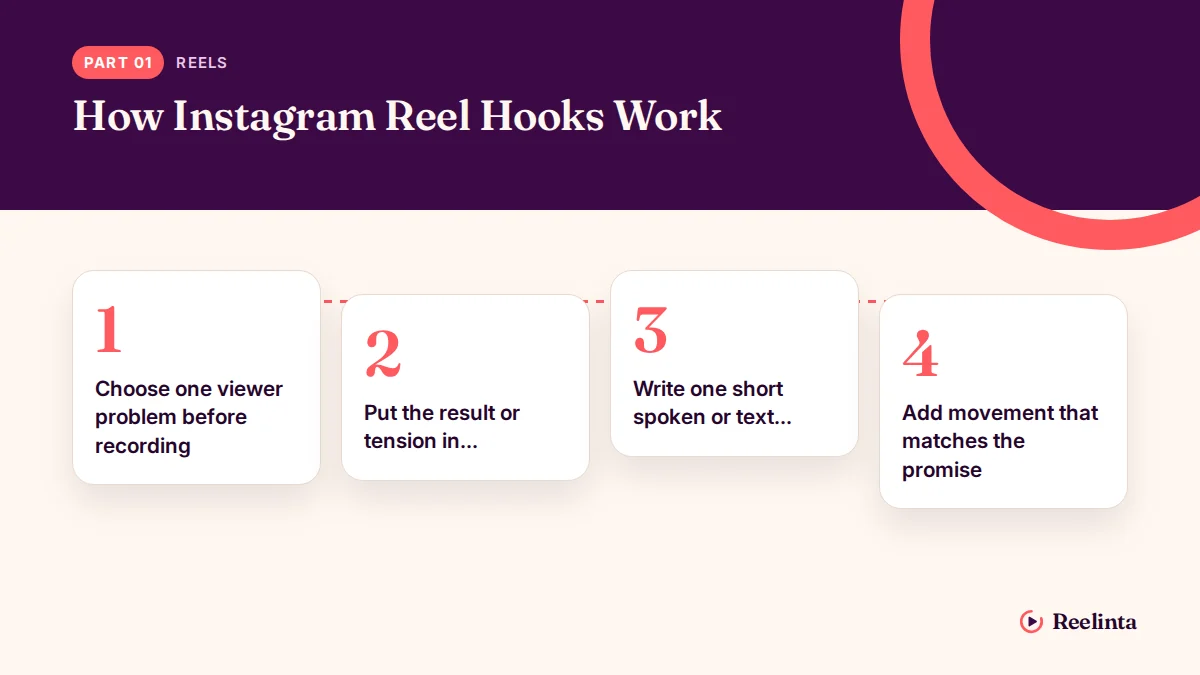
A useful hook moves a viewer from passive scrolling to active watching. The cycle below starts with one clear idea and ends with a Reel that gives the viewer the promised value.
-
Choose one viewer problem before recording. Write the exact issue your Reel will address, such as “my shirt looks wrinkled after packing.” Keep the idea narrow enough to explain in one video. This planning stage can take 5–15 minutes for a simple Reel, depending on how clear your subject already is.
-
Put the result or tension in the first frame. Show the finished dish, the damaged item, the before-and-after contrast, or the action that creates a question. Don’t hide the subject behind a logo or a long greeting. Record a few opening options, then compare which one makes the problem easiest to understand without sound.
-
Write one short spoken or text promise. Say what the viewer will learn, see, or avoid. For example, “Pack this fabric without deep creases” is clearer than “Here’s a useful travel tip.” Keep the promise true to the full video; changing the wording takes minutes, but correcting a misleading opening may cost trust.
-
Add movement that matches the promise. Cut to the action, move the camera toward the subject, or place the relevant object in view. Movement should explain the topic, not distract from it. For a talking Reel, record the first line with the matching gesture or screen example instead of adding unrelated motion.
-
Deliver the answer in the same order you promised it. If the hook names three steps, show all three. If it promises a comparison, show both choices and explain the difference. A short Reel may deliver its answer in under 30 seconds, but the correct length is the time needed to finish the promise without padding.
-
Review the opening with sound off. Check whether the first frame and on-screen words still show the subject. Then listen without looking at the screen to see whether the spoken line makes sense alone. If either version feels incomplete, change the matching part rather than adding more words everywhere.
-
Compare useful signals after publishing. Look at the views, watch time, shares, comments, and saves available in your Instagram insights. Don’t treat one result as proof that a hook always works. If viewers leave before the answer, test a clearer opening; if they watch but don’t act, improve the usefulness of the middle or ending.
Why Reel Hooks Lose Viewers
A Reel can contain accurate advice and still lose viewers because the opening doesn’t show why the advice matters. The first frame may be attractive but unclear, or the spoken line may start with background information before naming the actual problem.
A question works only when the viewer can imagine wanting the answer. “Do you make this mistake?” Is weak without a visible mistake or a clear subject. “Why does this cake sink after baking?” Gives the viewer a specific problem and creates a reason to continue.
The visual and words must support each other. If the screen shows a finished room but the text says “three budgeting errors,” the viewer has to work out the topic. That extra effort can make the Reel feel irrelevant before the useful part begins.
A hook also fails when it promises more than the video delivers. Saying “the only way” or promising a dramatic result may create a short burst of attention, but the trade-off is lower trust when the content gives ordinary advice. A smaller promise is less dramatic, yet it’s easier to prove.
The first action matters because stillness can hide the subject. A creator who begins with five seconds of a logo, a greeting, or a slow camera setup delays the answer. The cost isn’t only lost views; the viewer may also stop recognizing the account as a useful source.
The problem can sit outside the hook, too. A blurry video, quiet speech, tiny text, or a confusing caption can make a good opening hard to follow. In that case, rewriting the first sentence won’t fix the whole experience; improve the part that blocks understanding.
Instagram’s ranking systems use several signals, and a hook is only one part of a Reel’s performance. Instagram explains that its systems consider different signals for different surfaces, including information about the post and how people interact with it in its Instagram ranking explanation. Treat hook advice as a way to earn a fair first look, not a guaranteed reach formula.
If viewers leave during the opening, check clarity first: can they name the subject from the first frame? If they stay but don’t share or save, check the payoff; the Reel may be interesting without being useful. If both are weak, change the idea or audience match before polishing the wording.
What You Control in Reel Hooks
You can shape the message, the opening frame, and the order of information. You can’t control every viewer’s interest, Instagram’s distribution, or whether a particular sound remains popular.
You control
- The problem your Reel addresses and the specific viewer it serves.
- The first frame, opening action, and what appears before the first cut.
- The spoken line, text size, contrast, and placement.
- The promise, examples, and final payoff.
- The clarity of the edit, including whether each shot earns its place.
- The version you publish, so you can revise the hook instead of treating one result as proof.
Watch the opening with sound off before posting. If the main idea disappears, strengthen the first frame or on-screen text; if it remains clear, the hook isn’t relying on audio alone.
Fixed by design
- Viewers can swipe away instantly.
- Instagram decides distribution.
- People have different interests.
- Trends change over time.
If you’re changing account settings, using paid promotion, or making claims about health, money, or safety, stop before guessing. Check Instagram’s current help pages or ask a qualified professional for the subject-specific advice; a hook can improve attention, but it can’t make risky information correct.
Better Instagram Reel Hook Habits
Clear openings make hooks stronger because they follow the way viewers process information. They also reduce the time spent rewriting a Reel that was unclear from the start.
-
Write the payoff before the hook. State what the viewer should know or see at the end, then create an opening that points toward it. If you can’t describe the payoff in one sentence, the Reel probably has too many ideas. Make the payoff concrete enough to check against the finished video.
-
Use the clearest format for the subject. If the result is visual, show it first. If the answer depends on an explanation, use a direct spoken line with readable text. If the viewer needs a comparison, show both choices early instead of teasing one choice for the whole video. A visual result shouldn’t begin with a paragraph explaining what it will look like.
-
Match the hook’s promise to the available proof. Use “one way to” when you’re showing one method, not “the only way.” This gives up some drama, but it protects trust and leaves room for other valid methods. If the claim sounds broader than the examples, narrow the claim before publishing.
-
Remove greetings and setup that don’t help. Strong Reel hooks start with the problem, result, or action. Keep context that changes how the advice should be understood; cut context that only explains why you decided to make the video.
-
Read your own result before copying a trend. Compare the opening with the Reel’s watch time, shares, saves, and comments in Instagram insights. If one hook gets attention but weak engagement, don’t copy it blindly; find out whether the topic or the payoff caused the difference. Compare similar topics and formats when possible, and change one part of the opening at a time.
Hook performance varies with the subject, audience, format, and current distribution. Find your exact figure from the opening views alongside watch time and meaningful actions, rather than from views alone. A hook that attracts views but produces no useful response may be promising attention, not a successful Reel.
Frequently asked questions
Can a Reel hook be just text?
Yes, a Reel hook can use text alone when the words are readable and the first frame makes the subject clear. This works best when the text names a specific problem, result, or question and stays on screen long enough to process. If the topic needs movement or visual proof, add the relevant image or action.
Why do my Reel hooks get views but no followers?
Views without followers usually mean the opening attracts attention but the account gives no clear reason to return. The hook may solve a one-time question, use a broad trend, or hide what the account regularly offers. Check whether the Reel’s subject matches your profile and recent posts. If the content is useful but disconnected, add a clear next step, such as a related topic viewers can find on the account.
How long should a Reel hook be?
A Reel hook should usually take only the opening seconds, but Instagram doesn’t set one universal hook length for every subject. A visual result may work immediately, while a technical question may need a short sentence. Time your opening from the first visible action to the moment the viewer understands the promise. If that explanation takes too long, remove background details before shortening important words.
Is it safe to use a controversial hook?
Yes, a controversial hook can be safe when it states a fair question or a claim you can support. It becomes risky when it uses false information, personal attacks, dangerous instructions, or a promise designed only to shock. Check the full Reel against Instagram’s current rules before posting. If the topic involves medical, legal, or financial decisions, use qualified sources for the advice rather than relying on controversy to create attention.
What happens if my hook gives away the result?
Giving away the result can still work because viewers may want to learn the method, reason, or steps behind it. A visible before-and-after often makes the topic clear faster than a long tease. The risk comes when the result removes every unanswered question. If the viewer already knows the outcome, make the remaining value specific, such as showing how to repeat it or explaining why the result happened.
Does it matter if a Reel hook has a question?
Yes, a question matters when it describes a problem the intended viewer actually wants solved. A vague question creates little direction, while a specific one helps the viewer identify the benefit of watching. Use a direct statement instead if the answer is more important than the mystery. The question should also be answered in the Reel; leaving it unresolved may earn attention but weakens the content’s usefulness.
Conclusion
Before your next Reel, write three different opening lines for the same idea, then film the one that feels clearest and most natural. Watch where people lose interest, listen to comments, and adjust your next opening. With regular testing, you’ll learn what makes your audience pause—and what earns their attention long enough to stay.
Aiden Parker writes about Instagram strategy, features, and growth, covering everything from captions and hashtags to algorithms, analytics, and audience engagement. His content explores Reels, Stories, Highlights, profile optimization, and Instagram for Business, offering practical insights to help creators and businesses improve their content, reach the right audience, and build a stronger presence on the platform.